January 19, 2026
Building Open Digital States: How DPGs Create Value for Digital Public Infrastructure
Author: Gordon LaForge and Akash Kapur, with support from Jon Lloyd, Director of Advocacy and 50-in-5 Program Director, and Max Kintisch, Director of Research & Urgent Global Challenges, DPGA Secretariat
As governments around the world accelerate digital transformation, a quiet tension is shaping the global digital landscape. Digital technologies are spreading rapidly—especially across the Global South—yet control over core digital infrastructure is becoming increasingly concentrated in the hands of a small number of firms and countries. For policymakers, this combination of diffusion and dependency raises urgent questions about digital sovereignty, resilience, and long-term sustainability.
Digital public infrastructure (DPI) has emerged partly in response to this challenge. Foundational systems for identity, payments, and data exchange are increasingly seen not just as technical platforms, but as public infrastructure that underpins inclusive growth and effective governance. Within this shift, digital public goods (DPGs)—open-source software, open data, open AI systems, and open content that meet the DPG Standard—are playing a growing role as core elements of DPI.
But while interest in DPG-based DPI is growing fast, evidence of its real-world impact has remained thin, and fragmented. What value do DPGs actually create for governments and societies? And under what conditions do they deliver lasting benefits?
A new report, Building Open Digital States: Country Case Studies on the Impact of DPGs for DPI, helps answer these questions by combining a review of existing evidence with in-depth country case studies from the Philippines, Kyrgyzstan, and Rwanda. This report also contains a framework for how to understand the value of DPG adoption from an economic, social, governance, and political lens.
From Adoption to Impact: Why Evidence Matters
Much of the global conversation on DPGs has focused on adoption—the question of how many countries and users are using open-source platforms for digital ID, payments, or health systems. But adoption alone does not tell us whether these systems are delivering meaningful outcomes.
The report responds to growing calls from governments, multilaterals, and development partners for more rigorous evidence on the impact of DPGs for DPI. Rather than starting from abstract metrics, it asks a more grounded question: what do policymakers themselves hope to achieve when they adopt DPGs—and how does value actually show up in practice?
A Framework for Understanding the Value of DPGs
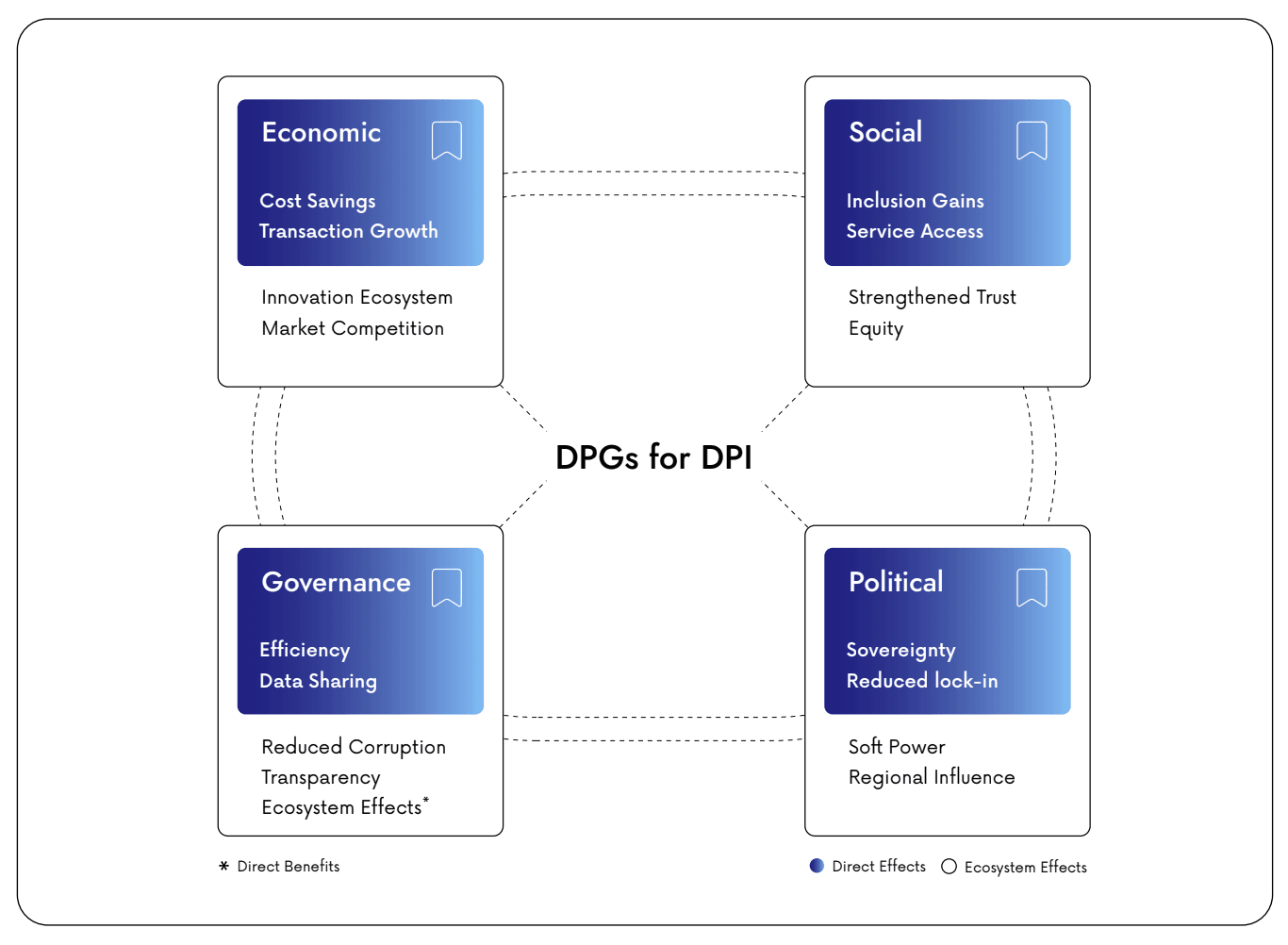
At the core of the report is a DPG-for-DPI Value Framework that identifies four dimensions of value that matter most to national decision-makers:
- Economic value: Including cost savings, reduced vendor lock-in, increased competition, increased innovation, and the stimulation of domestic digital markets.
- Social value: Expanding access to essential services such as health, identity, and payments—especially for underserved populations—and supporting progress toward the Sustainable Development Goals.
- Governance value: Strengthening state capacity, interoperability across institutions, data-driven decision-making, and anti-corruption efforts.
- Political value: Enhancing digital sovereignty, strategic autonomy, global participation, and a country’s ability to shape its digital future on its own terms.
Crucially, the framework also highlights ecosystem effects—the indirect, cumulative benefits that emerge over time, such as trust in public systems, local technical capacity, and innovation spillovers. These effects are often the hardest to measure, but they are frequently the most durable, and often these benefits only reveal themselves in the medium to long term.
What the Country Cases Show
The three country case studies illustrate how DPGs create value across these dimensions when embedded in coherent DPI strategies:
1. In the Philippines, open-source platforms such as MOSIP and Mojaloop are being used to reduce dependence on proprietary vendors, lower long-term costs, and expand financial inclusion—enabling millions of previously unbanked citizens to access formal financial services.
- Digital Autonomy and Ownership. The primary value proposition is gaining greater ownership and control over the country’s digital transformation path, after a history of disadvantageous experiences with external vendors.
- Cost-savings. DPGs offer the potential to save costs both for public agencies and citizens, such as a 95% reduction in the total cost of an interoperable instant payments system.
- Financial Inclusion. The introduction of PhilSys has enabled as many as 8.3 million additional Filipinos to open bank accounts and further gains to inclusion are expected from the scaling up of pilots.
2. In Kyrgyzstan, the X-Road–based Tunduk interoperability platform has saved citizens millions of hours by eliminating paper-based processes, while also serving as a powerful anti-corruption tool and reinforcing national control over sensitive data.
- Strategic Autonomy. The use of a DPG, via its open source nature, allowed the country to maintain control over its national data and avoid vendor lock-in.
- Economic Efficiency. In 2024 alone, the system saved citizens an estimated 21 million hours and 1.7 billion soms ($19 million).
- Market Innovation. The platform served as a foundation for the private fintech market, enabling open banking and new G2B business models.
- Social Contract. The system strengthened trust by making data silos and public service opacity a visible and quantifiable governance failure rather than an accepted reality.
3. In Rwanda, long-term investment in DPGs such as DHIS2 and Mojaloop has strengthened health outcomes, enabled a data-driven COVID-19 response, and catalysed a domestic innovation ecosystem—positioning the country as a regional leader in DPI.
- Strategic Autonomy. DPGs enabled Rwanda to own and govern core digital systems, avoiding vendor lock-in and maintaining sovereign control over national data and development path.
- Health System Transformation. DHIS2 improved data completeness from 88% to 95% and timeliness from 60% to 90%+, enabling targeted interventions. Maternal mortality fell by over 50% (476 to 203 deaths per 100,000 live births, 2010-2019). During Covid, Rwanda achieved 77%+ full vaccination coverage using DHIS2-integrated digital certificates and national ID linkage, ranking among top African performers in testing and vaccination.
- Innovation and Market Competition. Implementation of Mojaloop has eased market concentration and improved payments interoperability. It also increased the capacity and expanded customer base of local firms , demonstrating how DPGs can catalyze startup ecosystems.
- Regional Leadership. Rwanda exports DHIS2 and Mojaloop expertise to neighboring countries, and contributes innovations back to the global DPGecosystem. The country is recognized as a regional—and, increasingly, global—leader in the DPI space.
Across all three cases, DPGs are not simply cheaper software alternatives. They function as institution-building tools that reshape markets, strengthen governance, and expand state capacity.
Lessons for Policymakers and Practitioners
Several cross-cutting lessons emerge from the analysis:
- The impact of DPGs is as much political as social or economic. Although often unstated or under-recognized, political considerations–such as increased sovereignty, autonomy, and long-term institutional control—are among the most important benefits sought by policymakers. .
- Incremental implementation matters. Phased rollouts, parallel systems, and pragmatic integration with legacy infrastructure reduce risk and improve sustainability.
- Capacity-building is essential. Open code only delivers autonomy when governments invest in people, institutions, and local ecosystems.
- Incentives and mandates matter. DPGs succeed when institutional authority and market incentives align around interoperability and reuse.
- Crisis moments can accelerate impact. COVID-19 validated many DPG investments and helped lock in long-term political support.
Why This Matters Now
As more countries invest in DPI, choices made today will shape digital ecosystems for decades. The evidence in this report suggests that DPGs offer a credible pathway for countries to build open, inclusive, and resilient digital states—if they are implemented strategically and governed well.
Moving forward, the challenge is not whether DPGs work, but how governments, funders, and practitioners can better measure their impact, learn from real-world experience, and invest in the institutional foundations that allow DPGs to thrive.
The full report offers a deeper look at how to do that—and invites further research, collaboration, and evidence-building to strengthen the global DPG ecosystem.